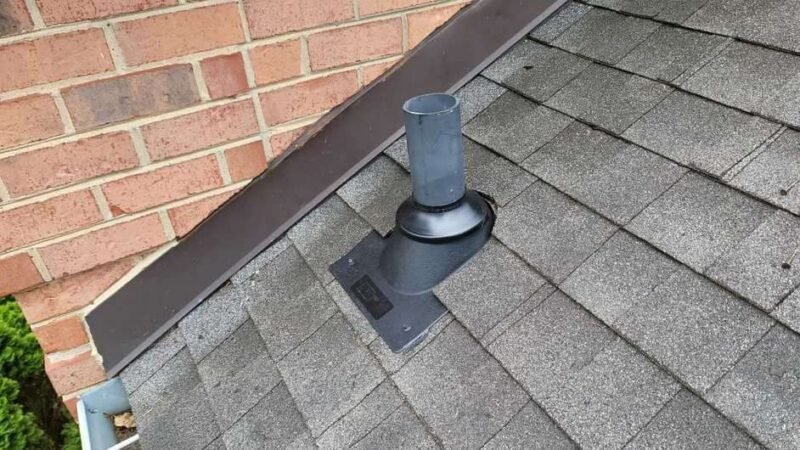
A pipe boot is a flexible rubber or silicone collar bonded to a metal or plastic base that fits around a plumbing vent pipe where it penetrates the roof. The collar grips the outside of the pipe tightly while the flat base integrates into the shingle layers — tucked under the shingles on the uphill side and resting on top of the shingles on the downhill side. The pipe boot is the only thing preventing rainwater from following the outside of the plumbing vent pipe straight down through the roof deck and into your attic.
The pipe it seals is not a random piece of metal poking through the roof. Every house with indoor plumbing has at least one vent pipe — usually two to four — that extends from the drain-waste-vent (DWV) system up through the roof. The vent pipe admits air into the drainage system so water can flow through the pipes without the glugging, slow-draining behavior that happens when a drain is not vented. It also vents sewer gases above the roofline so they do not accumulate in the plumbing system and bubble up through sink traps. The pipe boot keeps the outside of this pipe watertight at the roof penetration while the pipe itself performs its ventilation function inside.
Where Pipe Boots Are Located on Your Roof
Walk around your house and look at the roof. Every vertical pipe penetrating the roof surface that is 1.5 to 4 inches in diameter is a plumbing vent, and every one of those pipes has — or should have — a pipe boot around its base. The pipes are typically black ABS or white PVC, and they are usually clustered near the bathrooms and the kitchen because those are the locations where the drain lines are concentrated.
Common pipe boot locations:
- Above the main bathroom. The toilet, sink, shower, and bathtub all connect to vent pipes that join together in the attic and exit through a single roof penetration above the bathroom. This is the pipe boot most likely to leak because it serves the largest-diameter vent pipe — typically 3 or 4 inches — and the rubber collar is under the most tension.
- Above the kitchen sink. A smaller vent pipe, usually 1.5 or 2 inches, serves the kitchen drain. It may exit the roof separately or connect to the main vent stack in the attic.
- Above a basement bathroom or utility sink. Below-grade plumbing fixtures require vent pipes that typically run up through an interior wall and exit the roof separately from the main vent stack.
- The main soil stack. In older homes with cast-iron plumbing, the main vertical stack that carries waste from the upper floors also serves as the primary vent. It penetrates the roof as a 3- or 4-inch pipe — sometimes still cast iron, sometimes replaced with ABS or PVC during a remodel — and its pipe boot is the largest and most expensive on the roof.
The bath fan is NOT a pipe boot: A bathroom exhaust fan vent penetrating the roof uses a different type of flashing — a vent cap with an integrated flange — not a pipe boot. The pipe boot is specifically designed for a cylindrical pipe that extends above the roof. The bath fan cap is designed for a duct that terminates at the roof surface. Confusing the two leads to the wrong part and a leak that persists after the “repair.”
Pipe Boot Materials and How Long They Last
The flexible collar is the part of the pipe boot that fails. The metal or plastic base lasts as long as the shingles around it — 25 to 30 years for most installations. The rubber collar, exposed to direct sunlight and weather on the roof, lasts 10 to 20 years depending on the material.
| Collar Material | Typical Lifespan | Cost (Part Only) | Failure Mode |
| Neoprene (Rubber) | 10-15 years | $8-$15 | UV cracking at the collar-to-pipe contact line |
| EPDM Rubber | 15-20 years | $12-$25 | Gradual loss of elasticity, collar loosens |
| Silicone | 25-40 years | $20-$45 | Rare — tear if the pipe shifts laterally
∙ Lead (historic homes) |
| 50+ years | $25-$60 (specialty) | Tearing at the bend, corrosion at nail holes | ∙ |
The failure is predictable and visible. The rubber collar develops hairline cracks at the point where it grips the pipe — the point of maximum tension in the material. The cracks widen with every thermal cycle (hot day expands the collar, cold night contracts it) until one crack opens wide enough to admit rainwater. The water runs down the outside of the pipe, drips onto the attic insulation, and eventually stains the ceiling in the room directly below the vent pipe.
Lead pipe boots — correctly called lead pipe jacks — were standard on homes built before the 1970s. Lead is extremely durable (50-plus years), flexible enough to be formed around the pipe by hand, and does not crack from UV exposure. But lead is toxic. Handling a lead pipe jack without gloves and a respirator is a health risk, and replacing one requires proper disposal as hazardous waste. Most roofers will not touch lead flashing; they will refer the homeowner to a specialist or recommend replacing the entire vent pipe flashing with a modern silicone boot.
Pipe Boot Sizing: Getting the Right Fit for Your Vent Pipe
Pipe boots are sized by the inside diameter of the flexible collar, which must match the outside diameter of the vent pipe. The sizing is not universal — a pipe boot for a 2-inch ABS pipe will not fit a 3-inch PVC pipe, and forcing it creates a leak path at the collar.
| Vent Pipe Size (Nominal) | Actual Outside Diameter | Pipe Boot Size Needed | Typical Application |
| 1.5 inch | 1.90 inches (ABS/PVC) | 1.5-2 inch adjustable | Kitchen sink, individual lavatory vent |
| 2 inch | 2.375 inches (ABS/PVC) | 2 inch | Bathroom group, laundry vent |
| 3 inch | 3.50 inches (ABS/PVC) | 3 inch | Main vent stack through roof |
| 4 inch | 4.50 inches (ABS/PVC) | 4 inch | Main soil stack, large homes |
The pipe boot collar must fit snugly around the pipe without being stretched to the point of tearing. An adjustable pipe boot has a stepped or tapered collar with multiple diameter rings — the installer cuts the collar at the ring that matches the pipe diameter. The remaining collar above the cut grips the pipe. A fixed-size pipe boot fits one pipe diameter only and must be matched exactly to the vent pipe it will seal.
Pipe Boot Replacement Cost and Process
Replacing a pipe boot costs $200 to $500 for a single plumbing vent on an asphalt shingle roof. The roofer lifts the shingles around the existing boot, removes the old boot, slides the new boot’s base under the uphill shingles and over the downhill shingles, tightens a stainless steel hose clamp around the collar at the pipe, and nails the base flange to the roof deck. The nails are covered by the shingles when they are laid back down. The entire process takes 30 to 45 minutes.
The cost variation — $200 vs. $500 — is driven almost entirely by roof accessibility and pitch, not by the pipe boot itself. A single-story ranch with a 4:12 pitch and an easy ladder setup costs $200 to $300. A two-story colonial with a 10:12 pitch and a pipe boot in a valley between two dormers costs $400 to $500 because the roofer needs a taller ladder, fall protection, and more time to set up and break down safely.
Replacing all the pipe boots during a full roof replacement costs $150 to $250 per boot in addition to the roofing cost — less than replacing a single failed boot as a standalone service call because the roofer is already on the roof with the tools out, and the shingles around the boots are already being removed as part of the tear-off.
FAQ: Common Questions About Pipe Boots
Should I replace all the pipe boots at the same time?
If you are replacing the roof, yes. The marginal cost of replacing all the pipe boots during a roof replacement is $150 to $250 per boot, compared to $250 to $500 per boot as a standalone service call later. If you are not replacing the roof and one pipe boot has failed, replace that boot now, but inspect the others. If they are the same age and material, they are approaching the same failure — budget for replacing them within 2 to 3 years.
Can I replace a pipe boot without replacing the surrounding shingles?
Yes. The shingles around the pipe boot can be lifted, the old boot removed, and the new boot installed without replacing any shingles — provided the shingles are not brittle and do not crack when the roofer lifts them. On a roof over 15 years old, the shingles may be too brittle to lift without cracking, in which case the repair expands to include replacing the shingles in the immediate area around the pipe.
A Pipe Boot Is the Cheapest Part of Your Roof — and the Most Likely to Leak First
The rubber collar on a plumbing vent pipe is exposed to direct sun, rain, snow, and temperature swings from -20°F to 140°F — on the roof, in the open, every day, for 10 to 20 years. The shingles around it last 25 to 30 years. The rubber collar lasts half that time. When it cracks and water follows the pipe into the attic, the ceiling below gets a stain, and the homeowner calls a roofer for a $400 repair that should have been a $30 silicone boot installed during the last roof replacement.
When you replace your roof, pay for silicone boots on every penetration. The upgrade costs $200 to $400 for the whole house and buys 25 to 40 years of collar life — matching the shingles instead of failing halfway through their life.