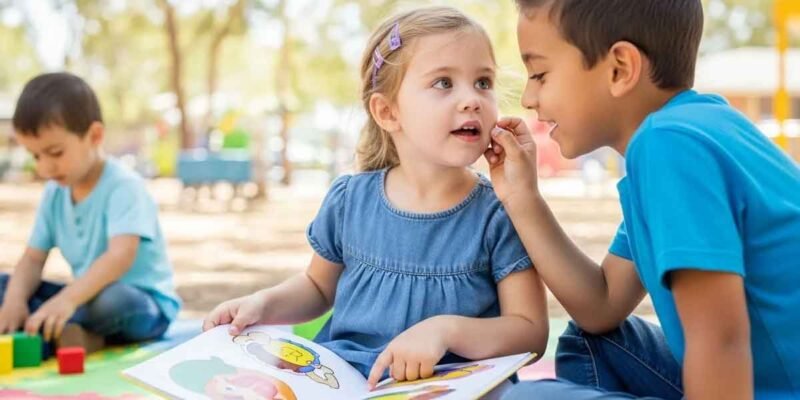
A child’s language development, from babbling to speaking, is crucial for their connection, learning, and future success. While children develop at different speeds, understanding language milestones helps parents provide effective support.
Mapping the Journey: Language Development Milestones
Language development is a cumulative process. Skills learned in infancy act as building blocks for the complex communication abilities used in preschool and beyond. While there is a wide range of “normal” when it comes to timing, most children progress through these stages in a predictable order.
Infancy (0–12 Months)
Long before they say their first word, babies are communicating. In the first few months, they rely on crying to signal needs, but they quickly learn to coo and make eye contact to engage with caregivers. By six months, babbling begins. You might hear repetitive sounds like “ba-ba” or “ma-ma.” Toward the end of the first year, babies often understand common words like “no” or “bye-bye” and may even produce their first true word.
Toddlerhood (12–24 Months)
This period often features a vocabulary explosion. Children typically start by using single words to label objects or express needs. By age two, many toddlers can put two words together to form simple phrases like “more milk” or “daddy go.” They also begin to understand simple instructions, such as “pick up the ball.”
Early Preschool (2–3 Years)
Between ages two and three, language becomes the primary way a child interacts with the world. Vocabulary grows rapidly, and children start using three-word sentences. This is also the age where the famous “why?” questions begin, signaling a leap in cognitive development and curiosity. Their speech should be understood by familiar listeners most of the time.
Preschool (3–5 Years)
By the time children reach preschool age, they are becoming sophisticated communicators. They can tell simple stories, use basic grammar rules (though mistakes are still common), and engage in longer conversations. They begin to understand abstract concepts like “yesterday” or “tomorrow” and can express complex emotions.
Bringing Words to Life: Activities for Home
You don’t need expensive educational toys to boost your child’s language skills. The most effective tools are already at your disposal: your time, your voice, and your attention. Here are practical ways to weave language learning into your daily routine.
The Art of Narration
One of the simplest strategies is to narrate your day. This technique, often called “sportscasting,” involves describing what you are doing as you do it. For example, while cooking, you might say, “I am chopping the red carrots. Chop, chop, chop. Now I am putting them in the hot pot.” This exposes children to new vocabulary and sentence structures in a meaningful context.
Dialogic Reading
Reading to your child is beneficial, but reading with them is even better. Dialogic reading encourages the child to become the storyteller. Instead of just reading the text, pause and ask open-ended questions about the pictures. Ask, “What do you think the bear is doing?” or “How do you think the girl feels?” This transforms a passive activity into an active conversation.
Follow Their Lead
Pay attention to what interests your child. If they are staring at a bug on the sidewalk, stop and talk about it. Describe its color, the number of legs it has, and how it moves. When you focus on what already captures their attention, they are more likely to retain the new words they hear.
Play and Pretend
Imaginative play is a laboratory for language. When children pretend to be doctors, chefs, or astronauts, they practice vocabulary specific to those roles. Join in the fun and introduce new scenarios that require negotiation and problem-solving, which pushes their language skills further.
The Power of Peers: Social Interaction and Language
While parents are a child’s first teachers, interaction with peers plays a crucial role in refining communication skills. When children play with adults, the adult often does the heavy lifting to keep the conversation going or to understand unclear speech. Peers, however, are less forgiving and more demanding communication partners.
Interacting with other children forces a child to clarify their message if they want to be understood. They learn the subtle rules of conversation, such as turn-taking, reading non-verbal cues, and listening actively. These social scenarios also provide a safe space to practice negotiation. Figuring out who gets to use the blue swing first requires complex language skills and emotional regulation.
Structured environments can be particularly helpful here. Enrolling your child in playgroups or summer programs for kids can provide consistent opportunities for this type of peer-to-peer learning. In these settings, children are motivated to communicate to participate in games and make friends, providing a natural incentive to expand their language abilities.
Finding Your Village: Resources and Support
It is natural for parents to compare their child’s progress to others, but it is important to remember that development varies. However, if you have concerns about your child’s language skills, trusting your instincts is vital. Early intervention can make a significant difference.
When to Seek Help
Consider consulting a professional if your child is not meeting major milestones, such as not babbling by 12 months, not using single words by 16 months, or if their speech is very difficult for others to understand by age three. Sudden regression—losing skills they once had—is also a reason to seek advice.
Professional Guidance
Start by speaking with your pediatrician, who can refer you to a speech-language pathologist (SLP). SLPs are experts in communication disorders and can conduct comprehensive evaluations. Additionally, many regions offer government-funded early intervention programs that provide low-cost or free services to eligible families.
Conclusion
Language development is a marathon, not a sprint, and progress can vary. The most effective way to support a child’s communication growth is by understanding developmental milestones, engaging in playful interactions, and providing an encouraging environment.