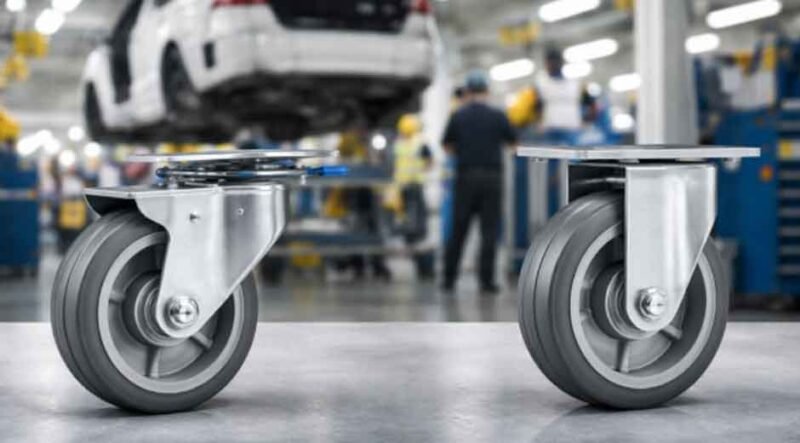
Automotive assembly lines are engineered for precision, efficiency, and safety. Every component—no matter how small—plays a role in keeping production moving smoothly. Mobility systems under carts, fixtures, and racks are often overlooked, yet they directly affect material flow, worker effort, and line uptime. Choosing between swivel casters and casters is not simply a hardware decision; it is an operational one that influences productivity, ergonomics, and long-term costs across the assembly environment.
In modern automotive plants, where just-in-time delivery, lean manufacturing, and high-throughput processes dominate, understanding how different mobility approaches perform under real-world conditions is essential. This article offers an objective comparison of swiveling and fixed mobility solutions, explores the trade-offs involved, and highlights the practical challenges that decision-makers must consider when designing or upgrading assembly line equipment.
Understanding Mobility in Automotive Assembly Lines
Assembly lines rely on a constant flow of parts: engines, transmissions, body panels, interior modules, and tools all need to move efficiently from one station to the next. Mobility systems are typically installed on carts, dollies, kitting racks, and workstations to enable this movement. While the basic function—rolling from point A to point B—sounds simple, the demands placed on these systems are anything but.
Automotive environments involve heavy loads, frequent starts and stops, tight turning radii, and long operating hours. Floors may vary between polished concrete, epoxy-coated surfaces, or areas with debris and metal shavings. In such conditions, the choice between swiveling and fixed wheel configurations affects not only how equipment moves, but also how safely and predictably it behaves during daily operations.
How Swiveling Mobility Systems Perform on the Line
Swiveling designs allow wheels to rotate freely around a vertical axis, enabling carts and equipment to change direction easily. This characteristic makes them particularly valuable in areas where maneuverability is critical.
Strengths in Automotive Applications
In automotive assembly lines, space is often constrained. Operators need to position carts precisely near workstations without disrupting surrounding processes. Swivel caster wheels excel in these situations by allowing smooth directional changes, even in tight aisles or crowded line-side areas. This reduces the physical effort required from workers, helping minimize fatigue and the risk of strain-related injuries.
Another advantage lies in adaptability. As assembly lines evolve—whether due to new vehicle models or layout optimizations—equipment with swiveling mobility can adapt more easily to new pathways and station configurations. This flexibility supports continuous improvement initiatives common in automotive manufacturing.
Challenges and Trade-Offs
However, increased maneuverability comes with trade-offs. Swiveling designs can be less stable when handling very heavy loads over long, straight distances. Without proper braking or directional control, carts may drift or require constant correction from operators. In high-speed environments, this can reduce efficiency and introduce safety concerns.
Additionally, swiveling mechanisms typically involve more moving parts, which can increase maintenance requirements over time. In assembly lines operating around the clock, wear on bearings and swivel joints must be monitored to prevent unexpected failures.
The Role of Fixed Wheel Configurations
Fixed wheel systems, often referred to as rigid setups, roll in a straight line and do not pivot. While this limits maneuverability, it provides advantages in control and stability.
Advantages in Automotive Settings
In sections of the assembly line where equipment moves repeatedly along the same path—such as between standardized stations—fixed caster wheels offer predictable, straight-line motion. This stability is particularly valuable when transporting heavy automotive components like powertrains or chassis assemblies.
Because they lack a swiveling mechanism, rigid designs generally have fewer wear points. This can translate into lower maintenance demands and longer service life, which is appealing in high-load, high-frequency environments. For facilities prioritizing durability and consistency, fixed mobility solutions often align well with operational goals.
Limitations to Consider
The main limitation of fixed designs is reduced maneuverability. Turning requires more space and effort, which can be problematic in compact assembly areas or when frequent repositioning is required. Operators may need to apply additional force to align carts, potentially increasing physical strain.
As assembly lines become more flexible and modular, relying solely on fixed mobility may restrict layout changes or slow down adjustments during process improvements.
Balancing Maneuverability and Stability
The core decision between swiveling and fixed mobility systems often comes down to balancing maneuverability with stability. Automotive assembly lines rarely operate under a single set of conditions; instead, they encompass a mix of straight-line transport, tight positioning, and frequent stops.
Many facilities address this by using hybrid configurations. For example, carts may feature swiveling wheels at one end and fixed wheels at the other, combining ease of steering with directional control. This approach illustrates a broader principle: the best solution is often context-specific rather than universally applied.
Decision-makers must evaluate how equipment is used throughout a full production cycle, not just in isolated moments. A setup that works well at one station may introduce inefficiencies at another if overall flow is not considered.
Load Capacity and Weight Distribution
Automotive components are heavy, and uneven weight distribution is common. Engines, axles, and body frames place significant stress on mobility systems. Both swiveling and fixed designs are available in high-capacity options, but performance under load differs.
Swiveling wheels can handle substantial weights, but their turning performance may degrade if loads are not evenly balanced. This can make carts harder to control and increase wear on swivel assemblies. Fixed caster configurations, by contrast, often provide more predictable performance under heavy, centralized loads.
Evaluating load characteristics—maximum weight, center of gravity, and frequency of movement—is critical. Ignoring these factors can lead to premature equipment failure or safety incidents, regardless of the wheel type chosen.
Floor Conditions and Environmental Factors
The condition of assembly line floors has a direct impact on mobility performance. Smooth, well-maintained surfaces favor maneuverable solutions, while uneven or debris-prone areas demand greater stability and durability.
Swiveling caster wheels may struggle on damaged floors or in areas with frequent obstructions, as misalignment can cause vibration or resistance. Fixed caster wheels tend to track more reliably in such environments, reducing the risk of sudden directional changes.
Temperature, exposure to oils or chemicals, and noise considerations also influence selection. Automotive plants often require materials and designs that withstand harsh conditions without compromising movement quality.
Ergonomics and Worker Safety
Worker safety is a central concern in automotive manufacturing. Mobility systems directly affect how much force operators must exert to move equipment. Excessive pushing, pulling, or steering effort can contribute to musculoskeletal injuries over time.
Swiveling designs generally reduce the effort needed to maneuver carts, particularly in confined spaces. This ergonomic advantage supports safer working conditions, especially in areas where manual handling is unavoidable. However, if poorly maintained or improperly matched to load conditions, swiveling systems can become difficult to control, negating their ergonomic benefits.
Fixed designs, while more stable, may require greater force to change direction. In high-frequency tasks, this can increase physical strain. Evaluating operator interaction with equipment is therefore just as important as assessing technical specifications.
Impact on Productivity and Line Efficiency
In automotive assembly lines, even small inefficiencies can accumulate into significant delays. Mobility choices influence cycle times, material availability, and overall workflow.
Swiveling systems can speed up positioning and reduce time spent aligning carts at workstations. This supports faster changeovers and smoother transitions between tasks. Fixed systems, on the other hand, can enhance efficiency in repetitive, linear movements by minimizing correction and ensuring consistent travel paths.
The challenge lies in aligning mobility solutions with actual process demands. Overemphasizing maneuverability where it is not needed—or stability where flexibility is essential—can hinder productivity rather than improve it.
Long-Term Cost and Maintenance Considerations
Initial purchase cost is only one aspect of mobility system selection. Over the lifespan of automotive equipment, maintenance, downtime, and replacement expenses often outweigh upfront savings.
Swiveling mechanisms may require more frequent inspection and servicing, particularly in high-load or high-use applications. Fixed configurations typically offer simpler maintenance profiles but may limit adaptability if production requirements change.
An objective evaluation considers total cost of ownership, including labor, downtime risk, and the potential need for future reconfiguration. Automotive manufacturers increasingly favor solutions that balance durability with flexibility to support long-term operational resilience.
Making an Informed Decision
Choosing between swiveling and fixed mobility systems in automotive assembly lines is not about identifying a single “best” option. It is about matching the right approach to specific operational needs, environments, and strategic goals.
Decision-makers should consider:
- How equipment moves throughout the entire assembly process
- The balance between maneuverability and directional control
- Load characteristics and floor conditions
- Ergonomic impact on workers
- Long-term maintenance and adaptability requirements
By evaluating these factors holistically, automotive facilities can implement mobility solutions that support efficiency, safety, and continuous improvement.
Wrapping Up
Mobility systems play a quiet but critical role in automotive assembly lines. The choice between swiveling and fixed configurations affects not only how equipment moves, but how effectively people work and processes flow. There is no universal answer; each approach offers advantages and challenges that must be weighed against real-world conditions.
An informed decision recognizes that assembly lines are dynamic systems. By carefully considering maneuverability, stability, load demands, and long-term impact, automotive manufacturers can select mobility solutions that enhance performance today while remaining adaptable for tomorrow.