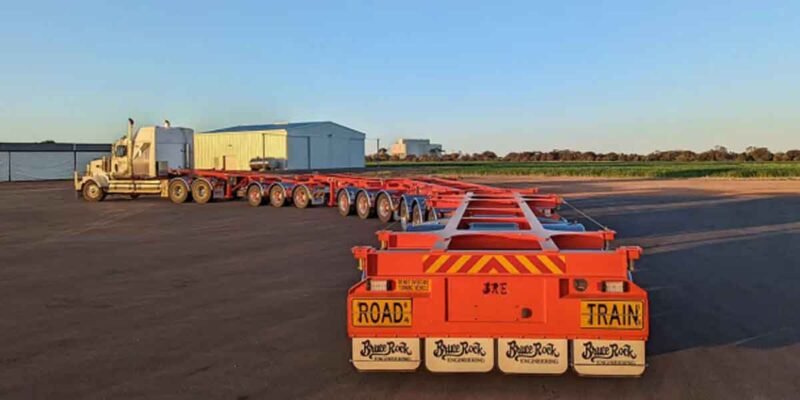
Turnaround time is what decides whether a container run makes money or just breaks even. Every extra minute a truck spends sitting at a terminal waiting to be loaded or lashed down is a minute it isn’t earning, and over a full day of port runs that adds up fast. This is the exact problem the skel trailer was built to solve, and it’s a big part of why the design has become the default choice for operators moving ISO containers rather than general freight.
A skeleton trailer strips the vehicle down to almost nothing but a frame and a set of twist locks. There’s no deck, no floor, no side rails, just enough steel to hold a container in place and carry it. It looks basic next to a flat top or a drop deck, but that simplicity is doing real work, and once you understand what it’s removing, it’s obvious why container operators keep coming back to it.
The Design Removes Everything a Container Doesn’t Need
A shipping container is already its own load-bearing structure. It doesn’t need a deck underneath it the way palletised freight or machinery does, so building a deck into the trailer just adds weight the truck has to haul around for no benefit. A skel trailer skips that step entirely and uses twist locks that engage directly with the corner castings on the container itself.
That’s a meaningful design decision, not a cost-cutting shortcut. Because the trailer isn’t carrying a deck structure, more of its rated capacity goes toward the container and its contents instead of the trailer’s own dead weight. On a loaded 40-foot box running close to the legal mass limit, that difference in tare weight is often the gap between a compliant load and an overweight one.
Loading Speed Is the Real Competitive Advantage
Ask most linehaul operators why they run skels and the answer usually comes down to time, not weight. A crane or reach stacker drops a container onto the trailer, the driver walks the twist locks over, and the truck is moving again in a few minutes. There’s no chain, no strapping, no dunnage to check and recheck at the next stop.
Compare that to a flat top carrying the same box lashed down instead of locked, and the difference in terminal dwell time is obvious. Multiply that gap across dozens of movements a week and it becomes a scheduling advantage, not just a convenience. A terminal that turns trucks around faster gets more runs booked into the same operating window, and that’s the kind of margin that shows up on the bottom line rather than just in the driver’s day.
Where Skels Actually Work in the Supply Chain
Skeleton trailers aren’t a one-application tool. They move containers between wharf terminals, rail yards, and inland depots, and they’re just as common on short port shuttle runs as they are on long linehaul routes between capital cities. That range is part of the appeal, because a fleet doesn’t need a separate trailer type for each leg of an intermodal job.
Manufacturers now build skel trailer ranges in a variety of lengths and load capacities to match that variety of work, including Performance Based Standards approved combinations, some running up to 42 or 60 metre configurations for operators who qualify for higher-productivity routes. Some ranges go a step further with tipping skels, which allow bulk product to be discharged directly from a container-style load. That gives an operator intermodal flexibility a standard flat top simply doesn’t offer, because the same unit can handle a straight container run one day and a bulk discharge job the next.
The Trade-Off Nobody Mentions Until It’s a Problem
Here’s the part that doesn’t get talked about enough. A skel is brilliant at one job and not much use at anything else. Try to load palletised freight, machinery, or timber onto a bare frame with no deck and you’ll understand why operators running mixed freight keep a flat top or drop deck in the yard as well.
That’s not a flaw in the skel, it’s just the nature of a purpose-built tool. A drop deck earns its keep by dropping the loading height enough to move tall plant under legal clearance limits, which is a different problem entirely from locking down a container in under a minute. Buying a skel because it’s popular, without checking whether your freight mix actually matches container work, is how operators end up with an asset that spends half its life parked.
What Actually Matters When You’re Speccing One
Length and PBS approval should be the first thing sorted, because that determines which combinations the trailer can legally run and which routes it qualifies for. After that, twist lock type matters more than most buyers expect. Some setups lock from one side only, others allow dual-side operation, and that choice affects how flexible the trailer is at terminals that load from either direction.
Axle and suspension selection is worth a proper conversation too. Air-bag suspension rides better on sealed highway runs and holds up well over the kilometres a linehaul skel typically covers, while a simpler setup can be perfectly adequate for short port shuttle work where the trailer barely leaves the terminal precinct. None of this is guesswork. It’s a matter of matching the spec to the actual duty cycle the trailer will run, and that’s a conversation worth having with a manufacturer before signing off on an order, not after the first breakdown on a route it was never built for.
The Bottom Line
Skeleton trailers dominate container transport because they solve the two problems that actually cost operators money: dead weight eating into payload, and dwell time eating into the schedule. They’re not the right choice for every job, but for straight container work between wharves, rail yards, and depots, nothing else comes close on speed or efficiency.
If container volume is a growing part of your freight mix and you’re still running general-purpose decks for it, that’s worth a second look. The right skel configuration, matched to your routes and your combinations, tends to pay for itself faster than most operators expect.