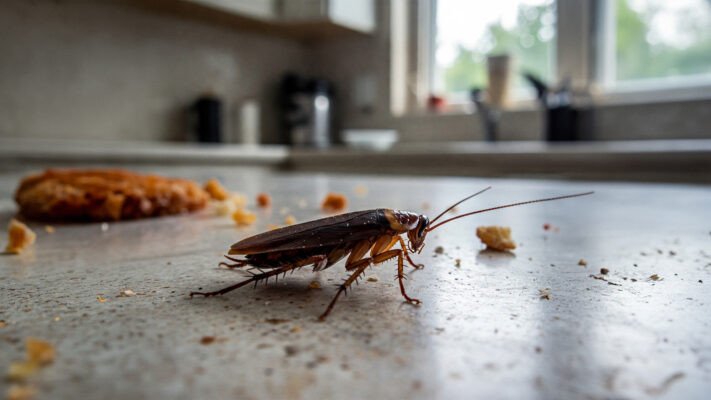
Getting rid of roaches in an apartment is fundamentally different from treating a single-family home. In a house, the roaches are your problem, and your treatment controls the entire environment. In an apartment, the roaches may be coming from a neighboring unit, and your treatment controls only your unit while the source — the infested apartment next door, the colony in the building’s wall voids, the grease trap in the shared trash room — continues to produce new roaches indefinitely. Treating an apartment for roaches without addressing the building-wide source is like bailing water from a boat while someone else drills holes in the hull. The water — the roaches — will keep coming until the drilling stops.
The apartment roach strategy has three parts that must be executed simultaneously: your own aggressive treatment of your unit, sealing every pathway between your unit and the rest of the building, and compelling your landlord to treat the building — or, if the landlord will not act, knowing your legal rights as a tenant. The first part — treating your own unit — is the same as treating any home: gel bait, IGR, dust, and sanitation. The second and third parts — sealing and landlord enforcement — are unique to apartment living and are the reason most apartment roach treatments fail even when the tenant does everything right.
Why Apartment Roaches Are Different: The Infestation Is Bigger Than Your Unit
| Single-Family Home Infestation | Apartment Infestation |
| Roaches originate inside the home or from the yard | Roaches originate from neighboring units, shared walls, common areas, and building infrastructure |
| You control the entire treatment environment | You control your unit only — you cannot treat the source if the source is a neighbor’s apartment |
| Treatment is self-contained — eliminate the colony, the problem ends | Treatment is a barrier — eliminate your colony, seal your unit, and hope the neighbor’s colony does not re-invade |
| Landlord is not involved (you are the homeowner) | Landlord is legally responsible for pest control in most jurisdictions — but enforcement varies |
| One treatment protocol — kill the colony | Two treatment protocols — kill your colony AND maintain a continuous preventive barrier |
Step 1: Treat Your Own Unit — Aggressively and Immediately
Your unit must be treated as though it is the only infested unit — because from the roaches’ perspective, it is. The fact that the source may be a neighbor’s apartment does not change the fact that the roaches in your kitchen, your bathroom, and your walls must be killed. Apply gel bait containing fipronil, indoxacarb, or hydramethylnon in pea-sized dots in every crack, crevice, hinge, and corner in the kitchen and bathroom: cabinet hinges, under countertop lips, behind the refrigerator and stove, around plumbing penetrations, along baseboards. Apply insecticidal dust — boric acid or diatomaceous earth — into wall voids behind electrical outlets and through the gaps around plumbing pipes under sinks. Apply an IGR — methoprene or pyriproxyfen — as a spray along baseboards and in cracks to prevent eggs from hatching. This is the same protocol described in detail in the full roach infestation treatment guide on this site. The difference in an apartment is that the treatment is not a one-time protocol. It is a continuous protocol — bait must be refreshed every 30 days, IGR every 4 to 6 months, because new roaches are continuously migrating into your unit from the building.
Step 2: Seal Every Pathway Between Your Unit and the Building
Roaches enter your apartment through specific, identifiable pathways. Every one of them can be sealed. The sealing is cheap, fast, and more effective than any insecticide at preventing re-infestation. A tube of silicone caulk costs $5 to $10. A can of expanding foam costs $5 to $8. The sealing materials for an entire apartment cost $30 to $60 and take 2 to 4 hours to apply. This is the single highest-return investment in apartment roach control — and the step most tenants skip because it feels like maintenance that the landlord should perform. The landlord should perform it. The landlord will probably not perform it, or will perform it poorly. Do it yourself. The $30 and 2 hours you spend sealing your apartment will do more to prevent roaches than a year of bait applications.
- Under the kitchen and bathroom sinks: Seal the gaps around the plumbing pipes where they enter the wall with expanding foam or silicone caulk. These gaps are the primary highway for roaches traveling between apartments through the plumbing chase.
- Behind the refrigerator and stove: Seal the gaps where the gas line and the water line enter the wall. Check for gaps in the wall behind the appliance — especially in older buildings, where holes from previous installations were never patched.
- Electrical outlets and light switches: Remove the cover plates. Apply a thin bead of caulk around the edge of the electrical box where it meets the drywall. Install foam gaskets behind the cover plates. Roaches travel through the electrical conduit between apartments.
- Baseboards and floor gaps: Run a bead of caulk along the gap between the baseboard and the floor, and between the baseboard and the wall. Roaches travel along these gaps from one end of the building to the other.
- Around radiators, heating pipes, and air vents: Seal gaps around heating pipes where they enter the floor or wall. Cover air vents with fine mesh screening if roaches are entering through the ductwork.
- The front door: Install a door sweep — a rubber or brush strip along the bottom of the door. Install weatherstripping around the door frame. Roaches enter through the gap under the apartment door from the hallway.
Step 3: Compel the Landlord to Treat the Building — and Know Your Rights
| Action | How to Do It | When to Escalate |
| Notify the landlord in writing. | Email or certified letter describing the infestation, the dates you first noticed roaches, the locations, and your efforts to control them. Photograph every roach sighting. Keep a log. | Immediately — written notice starts the clock on the landlord’s legal obligation to respond |
| Request building-wide treatment. | Ask the landlord to treat all adjacent units — above, below, and to both sides of your unit — simultaneously with your unit. A single-unit treatment in a multi-unit building will not work. | If the landlord treats only your unit and roaches return within 30 days |
| Contact local code enforcement or housing authority. | If the landlord does not respond within a reasonable time — typically 7 to 14 days — file a complaint with the local housing code enforcement office. An inspector will visit and may issue a citation requiring the landlord to treat the infestation. | After 14 days with no response or inadequate response from the landlord |
| Repair and deduct — or withhold rent. | In some states, tenants have the right to hire an exterminator themselves and deduct the cost from rent, or to withhold rent until the landlord addresses the infestation. State laws vary significantly. Consult a tenants’ rights organization before withholding rent. | Only after the landlord has been notified in writing and failed to act. Do not withhold rent without legal advice. |
The landlord’s legal obligation to control pests is nearly universal in the United States. The enforcement of that obligation varies by state, county, and the willingness of the tenant to assert their rights. The implied warranty of habitability — the legal doctrine that a rental unit must be fit for human habitation — includes freedom from pest infestations in every state. A roach infestation is a habitability violation. The question is not whether the landlord is responsible. The question is whether the tenant can make the landlord act. Written notice, documentation, and escalation to code enforcement are the tools that produce action. Silence produces nothing.
Step 4: Maintain a Continuous Preventive Barrier — the Apartment Difference
In a single-family home, once the infestation is eliminated, the treatment ends. In an apartment, once the infestation is eliminated in your unit, the treatment continues — because the building’s infestation continues. The preventive barrier is maintenance, not repair. It is the recognition that your apartment is a boat in infested waters, and the hull must be continuously maintained.
- Refresh gel bait every 30 days in the kitchen and bathroom — even when you see no roaches. The bait is a preventive barrier as well as a treatment.
- Reapply IGR every 4 to 6 months along baseboards and in cracks. The IGR prevents any roach that enters your unit from reproducing.
- Inspect your sealed entry points every 3 months. Caulk dries and cracks over time. Expanding foam degrades. Re-seal as needed.
- Maintain aggressive sanitation. No food left out overnight. No dirty dishes in the sink. No standing water. Garbage taken out nightly. The drier and cleaner your unit, the less attractive it is to roaches that are exploring from neighboring units.
FAQ: Common Questions About Apartment Roach Control
Should I move if my apartment has roaches and the landlord will not fix the problem?
If the landlord will not treat the building and the infestation continues despite your best efforts, moving may be the only permanent solution. Before moving, take photographs of the infestation, your written notices to the landlord, and any responses. If the landlord attempts to withhold your security deposit for breaking the lease, your documentation of the infestation and the landlord’s failure to act is your defense. In most states, a severe pest infestation that the landlord refuses to address is grounds to break the lease without penalty under the implied warranty of habitability. Consult a tenants’ rights organization before breaking the lease. The threat of legal action — backed by documentation — often persuades the landlord to release the deposit rather than defend an unwinnable claim.
Why do roaches keep coming back after the exterminator treats my apartment?
Because the exterminator treated your apartment — not the building. The roaches in your unit were killed. The roaches in the neighboring unit were not. Within days or weeks, roaches from the untreated unit migrated back into yours through the shared wall voids, plumbing chases, and electrical conduits. The treatment was effective. It was also incomplete. Ask the landlord or the exterminator whether the adjacent units — above, below, and to both sides — were treated simultaneously. If the answer is no, the treatment will fail regardless of how thoroughly your unit was treated.
Treat Your Unit. Seal Your Boundaries. Make the Landlord Treat the Building.
Getting rid of apartment roaches requires three simultaneous actions: aggressive treatment of your own unit with gel bait, IGR, and dust; sealing every pathway between your unit and the building with caulk, foam, and door sweeps; and compelling the landlord to treat the entire building by asserting your legal rights as a tenant. The first action kills your roaches. The second prevents new roaches from entering. The third addresses the source of the infestation — without which the first two actions will eventually fail. An apartment roach problem is a building problem that manifests in your kitchen. Treat it like one.