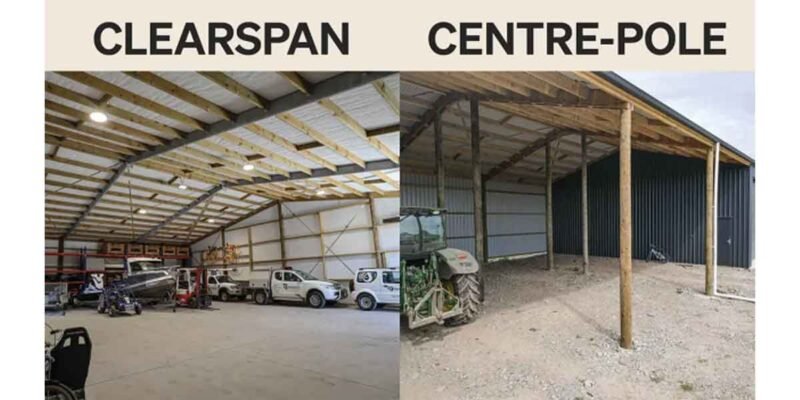
Choosing a farm shed sounds straightforward but you need to think about what gear you’re putting in your shed. A tractor may fit comfortably today, but what happens when you upgrade to a larger implement? Will centrepoles posts interfere with loading hay? And will the layout still make sense if the shed takes on a different purpose in ten years?
These questions matter because a farm shed is rarely just empty covered space. It becomes part of the daily movement of machinery, materials and people around your property.
Two common designs are clearspan and centrepole sheds. Neither should be selected on appearance alone. Your machinery, required span, storage plans, site conditions and future use all influence which structure makes sense.
This guide compares the two designs so you can make a more informed decision.
Table of contents
- What is a clearspan farm shed?
- How do centrepole sheds differ?
- Clearspan vs. centrepole at a glance
- Think about machinery movement first
- Consider how your storage needs could change
- Structural requirements and site conditions
- Cost versus long-term value
- Questions to ask before choosing
What is a clearspan farm shed?
A clearspan shed design is maximises space and eliminates internal obstructions. In a clearspan structure, the roof is supported by external walls and structural rafters rather than internal columns. This creates a fully open, spacious interior without any poles or supports in the middle, allowing for seamless movement and storage flexibility.
That can be particularly useful for large farm sheds used for machinery, hay, grain or other bulky materials. Without columns occupying the middle of the floor, you have greater freedom to decide where equipment goes and how vehicles travel through the building.
A clearspan layout can be especially useful when you need to:
- Reverse or turn large machinery inside.
- Store wide implements alongside tractors.
- Stack hay or produce efficiently.
- Reconfigure storage areas between seasons.
- Create workshop areas without designing around internal colums.
- Use large access openings.
The trade-off is that achieving a wide unsupported span requires the structure to transfer substantial loads to its perimeter. The engineering, member sizes and foundations therefore need to suit the span and site which can increase the cost
How does centrepole construction differ?
Centrepole sheds use vertical posts to support horizontal beams and the roof above. Internal supports can reduce the distance individual beams need to span. For relatively simple storage requirements, that can makecentrepole construction a practical solution.
The limitation becomes obvious when large machinery enters the equation.
Imagine trying to reverse a tractor and wide cultivator into a shed while avoiding a row of centrepoles. The building may technically have enough floor area, yet considerably less of that area is usable.
This is one reason farmers comparing large farm sheds should look beyond total square metres. The quality of the usable space matters just as much as the quantity.
Clearspan vs. clearspan at a glance
| Consideration | Clearspan | Centrepole |
| Internal columns | No internal poles, giving maximum usable space | Has internal posts |
| Machinery manoeuvring | More open and flexible | Posts restrict easy movement |
| Storage layout | Easy to reconfigure | Layout needs to account for posts |
| Wide spans | Well suited when appropriately engineered | Additional supports can make large areas practical |
| Future changes | High internal flexibility | Existing posts limit new layouts |
| Structural design | Requires more advanced engineering and structural reinforcements required to support the roof span without internal poles. | Loads can be distributed through the internal supports |
| Best suited to | Large machinery, flexible storage and multi-purpose spaces | Straightforward storage where internal poles are acceptable |
Think about machinery movement first
One of the easiest mistakes is designing a shed around the equipment you own rather than the way you actually use it.
Start by mapping vehicle movements.
Measure your widest tractor, harvester or implement, but also consider its turning circle and the space needed to attach or remove equipment.
Questions worth asking include:
- Will machinery drive straight through or reverse in?
- Can two machines pass each other?
- Where will implements be attached and detached?
- Will workshop activities take place beside stored machinery?
- Are doors positioned for natural vehicle movements?
- Could larger equipment be accommodated in future?
Consider how your storage needs could change
A farm shed built today may serve a completely different purpose a decade from now.
A machinery shed might later store hay. A section could become a workshop. Equipment itself is also likely to change in size.
This is where flexibility becomes an important part of the clearspan-versus-centrepole decision.
Clearspan structures give you more freedom to rearrange the floor space because there are no internal poles to work around. Racking and workshop areas can potentially be reorganised without having to work around structural columns.
Centrepole designs can still offer effective storage, particularly where assets are kept in specific bays. If you already know that certain areas will permanently hold pallets, bins or other relatively static materials, internal posts may cause little inconvenience.
The important point is to design around likely future workflows rather than simply filling today’s requirements.
Structural requirements and site conditions
Wind exposure, ground conditions, snow loads in certain regions, building dimensions, and intended use all influence the structural design. A layout that works on one farm may not suit the needs of another farm.
Material durability matters too. BRANZ guidance on exposed structural steel explains that moisture and contaminants can contribute to steel corrosion and highlights the importance of appropriate protection and maintenance.
That makes the specification of structural materials, protective treatments and connections just as important as deciding where the posts go.
Is the above info reall relevant? Unless we talk about clearspan vs centrepole for high snow load? Centrepoles can be cheaper, clearspan requires more engineering etc??? I dunno
Cost versus long-term value
It is tempting to compare shed designs using the initial price per square metre. That number is useful, but it does not tell the whole story.
Suppose one building costs less initially but requires machinery to be stored around several internal posts. If those posts leave awkward strips of unused floor area or make loading slower every day, the apparent saving needs to be considered alongside those operational compromises.
Think about whole-of-life value instead:
- How much floor space is genuinely usable?
- Can machinery enter and exit efficiently?
- Will the layout still work after equipment upgrades?
- How easy will the building be to maintain?
- Can its purpose change without major structural alterations?
- Maintenance should not be treated as an afterthought either.
A shed that works efficiently for several decades can represent better value than one chosen primarily because it had the lowest initial price.
Questions to ask before choosing
Before settling on either structural approach, put the plans aside for a moment and write down how the shed needs to work.
Ask yourself:
- What is the largest item going inside?Include machinery width, height, and turning requirements.
- How frequently will equipment move?Daily machinery storage has different requirements from seasonal hay storage.
- Do you need uninterrupted floor space?If yes, internal poles deserve careful consideration.
- Could the shed change purpose?Think ten or twenty years ahead where possible.
- What access points are required?Door size and location can be just as important as span.
- What environmental loads apply?Site-specific structural design matters.
- What does usable space really cost?Compare functional floor area rather than dimensions alone.
Design for the work your shed needs to do
There is no universal rule that says every farm building needs a clearspan structure or that centrepole construction is always the more economical answer.
The better choice depends on what happens inside the shed.
Centrepole construction can make good sense where storage is predictable and columns do not interfere with daily operations. Clearspan construction becomes particularly attractive when large machinery, changing storage requirements, and unrestricted movement are priorities.
Before comparing structural systems, map your machinery movements, storage zones and likely future requirements. Then look at span, engineering, access and cost.
A farm shed can stand for decades. The most useful design is not simply the one that accommodates today’s equipment — it is the one that continues to work as the farm around it changes.