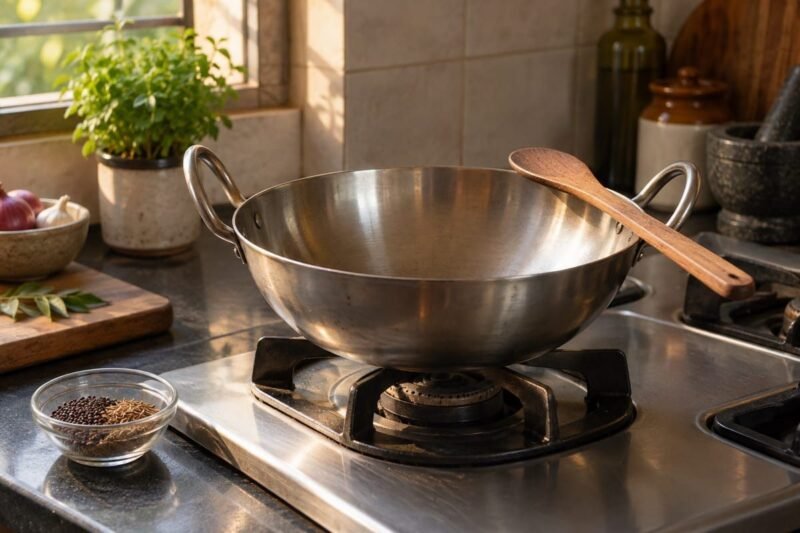
Indian food is hard on pans. You’re searing whole spices in hot oil one minute, then holding a curry at a bare simmer for forty minutes, then frying a batch of pakoras in two inches of oil. Few other cuisines ask a single piece of cookware to swing that far.
That’s why the question of which cookware suits Indian cooking doesn’t have one answer. It has three or four, depending on what you cook most and what sits on your counter.
Why heat response matters
Most Indian recipes start with a tempering step: oil, then mustard or cumin seeds, then aromatics, all in quick succession. A pan that lags behind your burner will scorch the seeds while you wait for it to react.
Thin aluminum heats fast but unevenly, so the center runs hot and the edges stay cool. Heavy cast iron holds heat beautifully but takes a long time to come down when you need to drop the temperature. Tri-ply stainless steel, with an aluminum core sandwiched between two steel layers, sits in the middle and spreads heat across the base without hot spots. That’s the construction worth looking for if you simmer slow curries regularly.
The kadai question
The kadai (deep, bowl-shaped, usually with two side handles) is the workhorse. Its depth keeps oil contained during frying and gives you room to toss vegetables without half of them landing on the hob.
Size tends to be where people get it wrong. A 2 to 2.5 liter kadai serves two to four people for everyday meals. Step up to 4 liters and you’re covering five or six servings, batch cooking, or doubling a recipe to freeze half. Anything under a liter is a side-dish pan, not a curry pan.
Depth matters as much as volume. Shallow pans invite oil spillage when you fry, and a crowded, shallow pan steams vegetables instead of browning them.
Nonstick or stainless steel cookware
Both have a real case. Hard-anodized aluminum nonstick heats quickly, needs noticeably less oil, and makes cleanup after a sticky tomato-based gravy almost trivial. It’s lighter in the hand too, which counts if you’re lifting a full pan off the stove several times a day.
The trade-off is lifespan. Coatings wear down, and metal utensils or repeated overheating speed that up. Plan on replacing a heavily used nonstick kadai every five to seven years, stick to wooden or silicone utensils, and keep the flame at medium-high rather than full blast. Modern PFOA-free coatings are rated for frying and are food-safe.
Stainless steel asks more of you at the start and less over time. Food-grade 18/8 steel won’t react with tamarind, tomato, or yogurt, so acidic gravies don’t pick up a metallic edge. There’s a short learning curve on sticking: preheat for a minute or two, add oil and wait for it to shimmer, then let food form a light crust before you move it. Steel releases on its own once it’s ready.
Cooktop compatibility
This is the detail that trips up the most buyers. Settle it before you buy anything else.
Round-bottom kadhais are traditional and ideal over a gas flame, but they wobble on flat electric surfaces unless you use a wok ring.
Flat-bottom pans sit stable on gas, electric, and induction alike.
Induction needs a ferromagnetic base. Tri-ply stainless usually qualifies; plain aluminum nonstick usually does not unless a steel disc is bonded underneath.
A fridge magnet on the base of the pan settles the question in two seconds.
If you’ve moved to an induction hob or expect to, that constraint narrows your options sharply, and comparing the best cookware for Indian cooking by base construction rather than by looks will save you a return. Plenty of attractive hammered-finish pans are gas-only.
Beyond the kadai
A kadai alone won’t cover an Indian kitchen. A tawa, flat or slightly concave, is what you need for roti, paratha, and dosa, and its even flat surface is the whole point. Cast iron tawas build up a seasoning layer over years; nonstick ones are more forgiving early on.
Then there are topes: straight-sided lidded pots, typically stainless, for dal, rice, and boiling milk. A nesting set in something like 33, 47, and 60-ounce capacities handles most daily jobs, and flat-fitting lids trap steam the way a thin loose lid never will.
A stone mortar and pestle still beats a grinder for small quantities of whole spice, because crushing releases the oils rather than heating and scattering them.
Handles and lids
Two short side handles suit deep-frying and carrying a heavy pan to the table. A single long handle suits stir-frying, where you want to shake the pan with one hand.
Rosewood stays cool longest but wants occasional oiling. Plastic warms during sustained high heat and is cheap to replace. Either way, check that handles are riveted through rather than welded on, since welds are what fail when a full 4-liter pan is in motion.
Glass lids let you watch a simmer without releasing steam; steel lids hold heat better. A no-drip flange on the rim is a small feature that matters every time you pour.
Caring for stainless cookware
Stainless needs no seasoning. Hand-wash it, dry it right away to avoid water spots, and reach for a baking soda paste on stubborn residue rather than a steel scrubber.
A pan you can’t comfortably lift when it’s full of curry is the wrong pan, no matter how good the construction is on paper. That single test will rule out more cookware than any spec sheet.