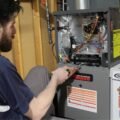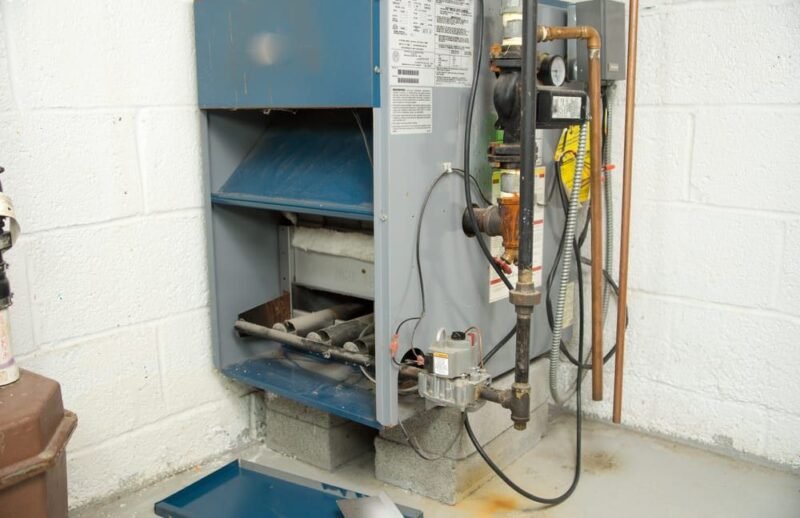
A condensing gas furnace is a high-efficiency heating system that extracts extra heat from its own exhaust gases before they leave the house. Where a standard furnace sends hot combustion gases straight up the chimney, a condensing furnace runs those gases through a secondary heat exchanger, cools them until the water vapor inside condenses into liquid, and captures the latent heat released during that phase change. The result is an efficiency rating of 90% to 98.5% AFUE — roughly 15 to 20 percentage points higher than a conventional 80% furnace.
The Department of Energy classifies condensing furnaces as “high-efficiency heating systems” and identifies three defining features: a secondary heat exchanger that condenses flue gases, sealed combustion that draws outside air directly into the burner, and acidic condensate that must be drained rather than vented up a chimney. Every one of those features changes how the furnace is installed, maintained, and priced compared to a standard unit.
How a Condensing Gas Furnace Works: The Two Heat Exchangers
A condensing furnace burns natural gas or propane in a sealed combustion chamber, producing a flame that reaches roughly 1,700°F.
The combustion gases pass through the primary heat exchanger (a set of serpentine metal tubes) where the furnace blower pushes return air across the outside of the tubes, heating the air that flows into your ductwork.
At the exit of the primary heat exchanger, the combustion gases are still around 350°F. In a standard 80% furnace, those 350°F gases go straight out the flue and up the chimney.
In a condensing furnace, those gases enter a secondary heat exchanger made of stainless steel. The blower pushes air across this second exchanger too, pulling more heat out of the combustion stream.
The gases cool below their dew point (roughly 135°F for natural gas combustion), and the water vapor produced by burning methane (CH4 + 2O2 → CO2 + 2H2O) condenses into liquid water.
That condensation releases roughly 970 BTU of latent heat per pound of water — energy that a standard furnace vents outside and a condensing furnace captures. The condensate, which is slightly acidic (pH 3.5 to 5.0, roughly the acidity of tomato juice), drips into a collection tray and drains through a PVC pipe to a floor drain or condensate pump.
The cooled exhaust gases, now around 100°F to 120°F, leave through a PVC pipe instead of a metal chimney.
The physics in one sentence: A standard furnace wastes the latent heat of vaporization locked in its own combustion water vapor. A condensing furnace recovers that heat by forcing the water to change phase from gas to liquid inside the heat exchanger, and it captures the energy released during that transition.
AFUE Ratings: What the Efficiency Numbers Actually Mean
AFUE stands for Annual Fuel Utilization Efficiency. The Federal Trade Commission requires every new furnace sold in the U.S. to display its AFUE rating. The number is a percentage: an AFUE of 95% means that 95% of the energy in the fuel becomes useful heat for the home over the course of a typical heating season, and 5% is lost, mostly as heat that escapes through the exhaust.
The Department of Energy groups furnaces into three efficiency tiers:
| Efficiency Tier | AFUE Range | Technology | Venting | Typical Year Installed
|
| Low-efficiency | 56-70% | Natural draft, standing pilot | Masonry chimney | Pre-1992 |
| Mid-efficiency | 80-83% | Induced draft, electronic ignition | Metal B-vent or chimney | 1992-2015 |
| High-efficiency (condensing) | 90-98.5% | Secondary heat exchanger, sealed combustion | PVC pipe through wall | 2010-present |
The jump from 80% to 95% AFUE saves roughly 15% to 20% on the heating portion of your utility bill. For a home in a cold climate spending $1,200 per year on natural gas for heating, that is $180 to $240 per year — enough to recover the price premium of a condensing furnace in 5 to 8 years. In a mild climate where the heating bill is $400 per year, the same percentage savings works out to $60 to $80 annually, and the payback stretches past 15 years.
The DOE estimates that upgrading from a 56% AFUE furnace to a 90% AFUE condensing furnace saves 1.5 tons of CO2 per year for natural gas and 2.5 tons for oil. That calculation treats the condensing furnace as one of the single most effective residential energy upgrades available, second only to adding attic insulation in terms of cost per ton of carbon avoided.
Condensing vs. Standard Furnace: The Key Differences
Beyond the efficiency number, condensing furnaces differ from standard 80% units in several practical ways that affect installation, maintenance, and cost.
| Feature | Standard (80% AFUE) | Condensing (90-98.5% AFUE)
|
| Heat exchangers | 1 (primary only) | 2 (primary + stainless steel secondary) |
| Exhaust temperature | 300-400°F | 100-120°F |
| Exhaust pipe | Metal B-vent or masonry chimney | PVC or CPVC through a side wall |
| Combustion air | Drawn from inside the house | Drawn from outside (sealed combustion) |
| Condensate | None | Acidic water, requires drain |
| Blower motor | Usually single-speed PSC | Almost always ECM variable-speed |
| Equipment cost | $1,200-$1,800 | $2,500-$5,000 |
| Typical lifespan | 15-20 years | 18-22 years |
The PVC venting is the most visible difference from the outside. Walk past a house built or renovated in the last decade and look for two white PVC pipes poking through an exterior wall near ground level. The larger pipe (typically 2 or 3 inches) is the exhaust. The smaller or identical pipe next to it is the combustion air intake. Together they form the sealed combustion system — the furnace never touches air from inside the house.
Sealed combustion matters for two reasons. First, it eliminates backdrafting: the risk that combustion gases, including carbon monoxide, get pulled into the living space instead of going up the chimney. Second, it avoids the energy penalty of using already-heated indoor air for combustion and then sending that heated air out the flue.
Condensate Management: The Plumbing You Did Not Know Your Furnace Needs
Every condensing furnace produces roughly 5 to 10 gallons of acidic water per day during peak heating season. That water has to go somewhere. If the furnace is in a basement with a nearby floor drain, gravity handles the problem — a ¾-inch PVC pipe runs from the furnace’s internal collection tray to the drain.
If the basement has no floor drain, the installer adds a condensate pump: a small electric pump in a plastic reservoir the size of a shoebox that activates when the water level rises. The pump pushes the condensate through ¼-inch vinyl tubing to a laundry sink, a washing machine drain, or outside. The pump costs $60 to $150 and adds about an hour to the installation. It hums briefly every time it runs — roughly every 30 minutes during a cold spell.
The three most common condensate problems, in order of frequency:
- Frozen discharge line: In an unconditioned basement or crawlspace, the vinyl tubing freezes on a sub-zero night. The pump keeps trying, the reservoir overflows, and the furnace shuts down on a safety float switch. The fix is insulating the tubing or routing it to an interior drain.
- Clogged trap: Dust, debris, and algae can block the internal condensate trap. The furnace shuts down because the pressure switch senses a blocked exhaust path. The fix is cleaning the trap during annual maintenance — a 10-minute job.
- Neutralizing the acidity: The condensate is mildly acidic and can corrode cast-iron drain pipes over many years. Some local codes require a condensate neutralizer — a small canister of calcium carbonate media that raises the pH before the water enters the plumbing. The media needs replacement every 1 to 2 years at a cost of $30 to $50.
What a Condensing Furnace Costs to Buy and Run
A condensing furnace costs more to buy and install than a standard 80% unit, primarily because of the secondary heat exchanger, the variable-speed ECM blower, and the additional labor for PVC venting and condensate drainage. The price premium ranges from $1,500 to $3,000 depending on the brand and the installer.
| Furnace Type | Installed Total | Annual Fuel Cost (Cold Climate, 2,000 sq ft) | Yearly Savings vs. 80% AFUE
|
| Standard 80% AFUE | $2,500-$3,800 | $1,100-$1,400 | Baseline |
| Condensing 92% AFUE | $4,000-$5,500 | $900-$1,100 | $200-$300 |
| Condensing 95% AFUE | $4,500-$6,500 | $800-$1,000 | $300-$400 |
| Condensing 96% AFUE (two-stage) | $5,000-$7,000 | $750-$950 | $350-$450 |
| Condensing 98.5% AFUE (modulating) | $5,500-$8,500 | $550-$800 | $550-$600 |
Federal tax credits under the Inflation Reduction Act cover condensing furnaces with AFUE of 97% or higher, up to $600 through 2032. Additional state rebates can push the net cost down by another $500 to $1,250 depending on location.
When a Condensing Furnace Makes Sense, and When It Does Not
A condensing furnace is not automatically the right choice for every home. The decision comes down to three factors: climate, gas prices, and how your existing furnace vents.
Cold climates (3,000+ heating degree days): A condensing furnace almost always pays for itself within its lifespan. The annual savings on fuel cover the price premium in 5 to 8 years, and the improved comfort from the variable-speed blower and sealed combustion is a bonus. In Minneapolis, Chicago, Boston, or Denver, a condensing furnace is the default recommendation.
Moderate climates (1,500-3,000 HDD): The decision is close. A $2,000 price premium saved over 18 years at $120 per year in fuel savings puts you about $160 ahead — barely breaking even. If the existing chimney needs a liner anyway (a $1,000+ expense), the condensing furnace looks better because PVC venting eliminates the chimney entirely.
Mild climates (< 1,500 HDD): A condensing furnace rarely makes economic sense on fuel savings alone. The annual heating bill is so low that saving 15% of it does not recover the price premium within the furnace’s lifespan. The exception is if you plan to convert the old chimney for another use (like a wood stove or a separate water heater vent) — in that case, the PVC side-wall venting of a condensing furnace solves a real space constraint.
Homes with no convenient condensate drain: If the furnace sits in an attic or a crawlspace with no nearby drain, a condensing furnace is a problem. The condensate pump needs to push water somewhere that will not freeze, and running tubing through finished ceilings is expensive. In these situations, a standard 80% furnace (or a heat pump) may be the better choice.
Quick test: Is your current furnace vented through a metal pipe into a masonry chimney? If yes, and you plan to stay in the house at least 7 more winters, replacing it with a condensing furnace will almost certainly pay for itself. If your furnace vents through PVC already, you already have a condensing furnace and the question is about upgrading to a higher-tier condensing model.
FAQ: Common Questions About Condensing Gas Furnaces
How do I know if my current furnace is condensing or not?
Look at the exhaust pipe. If it is white PVC plastic running to a side wall, it is a condensing furnace. If it is metal (silver galvanized steel or double-wall B-vent) running into a chimney, it is a standard 80% furnace. You can also check the AFUE sticker on the inside of the front panel — 90% or higher means condensing.
What happens if the condensate line freezes?
The furnace shuts down. A pressure switch detects that the exhaust path is blocked by ice or backed-up water, and the control board cuts the gas valve. The furnace will not restart until the blockage clears. This is a safety feature, not a defect — but it is why exterior condensate drains in cold climates must be insulated or routed indoors.
Does a condensing furnace last as long as a standard furnace?
Condensing furnaces typically last 18 to 22 years, compared to 15 to 20 years for a standard 80% unit. The secondary heat exchanger is made of stainless steel for corrosion resistance. The variable-speed ECM blower also experiences less wear because it runs at lower speeds most of the time. The main failure point is the condensate system — drains and traps that clog — rather than the heat exchangers themselves.
Are condensing furnaces required by law?
Yes, in certain regions. The DOE established minimum AFUE standards in 1992 that require 90% AFUE for furnaces installed in northern states (roughly the top third of the continental U.S.). In southern states, the minimum is 80% AFUE. If you live in the northern zone and are buying a new furnace, it will be a condensing furnace by law. The specific boundary is defined by climate zone in the federal regulations.
Is a condensing furnace noisy?
At the furnace itself, no — the sealed combustion chamber and variable-speed blower make it quieter than an 80% furnace. The exhaust exiting through PVC at the side of the house produces a steady low hum and a visible plume of water vapor on cold days. That plume looks like smoke but is just condensing water vapor from the combustion process.
Can a condensing furnace exhaust through the roof instead of a side wall?
Yes. PVC venting can go vertically through the roof using the same pipe. This is common in townhouses and homes where a side-wall vent would be too close to a property line, window, or walkway. The installation is more expensive (roof penetration requires flashing and sealing) but functionally equivalent.
A Condensing Furnace Recycles Waste Heat That Standard Furnaces Throw Away
The concept is simple: capture the heat locked in the water vapor produced by combustion, instead of venting it outside. The execution requires a stainless steel secondary heat exchanger, sealed combustion, PVC venting, and a drain for acidic condensate. The payoff is 90% to 98.5% efficiency and a heating bill that is 15% to 40% lower than an 80% furnace.
In a cold climate with a long heating season, the math works. In a mild climate, the price premium is harder to recover. In either case, looking at your furnace’s exhaust pipe tells you which category you are already in: metal means standard, PVC means condensing. If it is metal and the furnace is past its 15th birthday, the next one will almost certainly be PVC.