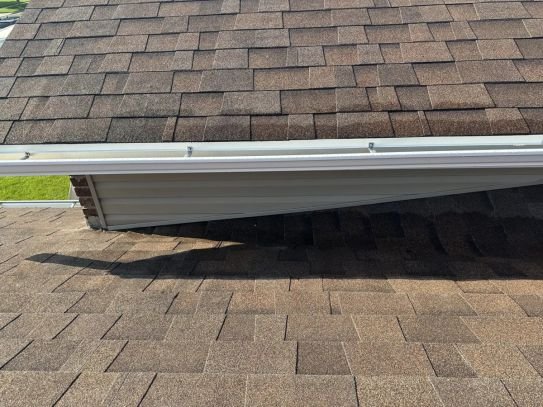
A dead valley is a section of a roof valley where water flow stops or slows to a near standstill because the roof planes that feed into it do not have enough slope to carry the water all the way to the eave. Water enters the valley from two steep roof sections, hits a flat or nearly flat area where the valley flattens out, and pools instead of draining. The water sits there after every rain — on the shingles, against the flashing, in the debris that inevitably collects in the crease — until it either evaporates or finds a way under the roofing material.
The name is literal: it is a valley that is “dead” because water does not flow through it the way it flows through a properly sloped valley. A living valley moves water. A dead valley holds water. And a valley that holds water on a roof is a valley that leaks — not because of a single rainstorm, but because water sitting in the same spot for hours after every rain destroys the roofing material from the top down.
Where Dead Valleys Form on a Roof
Dead valleys are almost always the result of a roof design that prioritizes appearance or interior space over drainage. They do not happen by accident — they are designed into the roof by an architect or builder who did not account for how water actually moves once the shingles are installed.
The most common dead valley locations:
- Behind a dormer where the dormer roof meets the main roof at a shallow angle. The main roof slopes down, the dormer roof slopes down, but the valley where they meet runs nearly horizontal for several feet before it turns downhill. Water pours into that horizontal section from both roof planes and cannot escape fast enough. This is the single most common dead valley in residential construction.
- At the intersection of a porch roof and the main house wall. A porch roof with a low slope that runs into the house wall creates a valley that is almost flat along the wall line. Water runs down the porch roof, hits the wall, and pools along the entire length of the wall instead of draining to one end.
- Where a garage roof ties into the house at a different roof height. When the garage roof is lower than the main roof and the connecting roof section is nearly flat, the valley where the three planes meet becomes a dead zone.
- At the base of two converging roof planes with a low-slope exit. A situation where two steep roof sections dump water into a valley that has less than a 3:12 pitch on its exit path. The volume of water arriving exceeds the valley’s drainage capacity, and water backs up into the valley like a traffic jam.
How to identify a dead valley from the ground: Look at the valley where two roof planes meet. If the valley line appears nearly horizontal — running sideways across the roof rather than diagonally down toward the eave — and if you can see debris, dark staining, or moss accumulation along that line, you are looking at a dead valley. A properly functioning valley is a diagonal line that is clean, dry, and free of standing debris.
Why Dead Valleys Leak: The Three Failure Mechanisms
A dead valley is not a leak waiting to happen — it is a leak that is already happening, slowly, over years, in ways that are invisible from the ground until the ceiling stain appears.
Standing water degrades every roofing material it touches. Asphalt shingles are designed to shed water, not to be submerged in it. Water that pools in a dead valley after a rain saturates the shingle granules, softens the asphalt mat, and accelerates granule loss. The shingles in a dead valley wear out in 8 to 12 years, while the shingles on the rest of the roof last 20 to 30. The dead valley becomes a strip of prematurely aged roofing material in the middle of an otherwise sound roof.
Ice damming is magnified in a dead valley. In cold climates, snow melts on the warm roof above the valley, runs into the dead zone, and refreezes because the pooled water is shallow and loses heat faster than flowing water. The ice builds up layer by layer until it forms a dam that forces subsequent meltwater under the shingles and up under the flashing. An ice dam in a dead valley is worse than an ice dam at the eave because it is harder to access and the water it forces under the roof material sits directly above the living space.
Debris accumulation becomes self-reinforcing. The first few leaves that land in a dead valley stay there because there is no flowing water to wash them out. Those leaves trap more leaves. The pile holds moisture against the shingles 24 hours a day, seven days a week, for weeks after the last rain. The shingles never dry out. The organic debris rots, producing acidic compounds that attack the shingle surface and the metal flashing underneath. What starts as a drainage problem becomes a chemical attack on the roofing materials.
How to Fix a Dead Valley
Fixing a dead valley is a roofing project, not a maintenance task. The solutions range from moderate to major, depending on the severity of the dead zone and the roof’s construction.
| Solution | Cost Range | Effectiveness | When to Use |
| Install a cricket or saddle | $800-$2,500 | Permanent fix | Dead valley behind a dormer or chimney |
| Widen and deepen the valley flashing | $600-$1,800 | Improves drainage, not a full fix | Mild dead zones with slight pooling |
| Install a tapered metal pan under the valley | $1,000-$3,000 | Permanent fix | Long horizontal valleys between roof planes |
| Redirect roof plane drainage | $1,500-$4,000 | Permanent fix | Major redesign, usually at roof replacement |
| Replace valley shingles with metal valley liner | $400-$1,200 | Extends life 5-10 years | Temporary improvement on budget |
A cricket or saddle is the standard fix for a dead valley behind a dormer. The cricket is a small peaked roof structure built in the dead zone to divert water to either side of the dormer, eliminating the flat spot entirely. It is framed with lumber, sheathed with plywood, and covered with shingles or metal matching the roof. A cricket costs $800 to $2,500 depending on the dormer width and is the only fix that permanently solves a dormer dead valley without redesigning the roof.
A tapered metal pan is a custom-fabricated metal liner that is installed under the shingles in the dead valley. The pan is shaped with a continuous slope from the high end to the low end, so that water entering the valley hits the metal slope and drains even though the roof structure underneath is flat. The pan is made of 24-gauge Galvalume steel or copper and must be fabricated by a sheet metal shop to the exact dimensions of the dead zone. It costs more than a cricket but requires no structural roof modification — it goes under the existing shingles.
Preventing Dead Valleys in New Roof Construction
A dead valley is always a design error, never a maintenance failure. Preventing one during new construction or a roof replacement costs a fraction of what it costs to fix one later.
- Maintain a minimum 3:12 pitch through every valley exit path. The IRC requires a minimum roof slope that matches the roofing material, but it does not specifically regulate valley drainage slope. A valley that meets code for the roofing material but has a flat exit path will still form a dead zone. The practical minimum for valley drainage is 3 inches of fall per foot.
- Design dormer valleys to drain around the dormer, not into a flat spot behind it. A dormer should be positioned so that the valley behind it slopes continuously to the eave on both sides. If the dormer is too wide for the roof pitch to allow that, split the valley with a cricket during construction.
- Avoid converging low-slope roof planes without a dedicated drain path. When two low-slope roof sections meet, the valley should be designed as a flat-roof drain with a scupper or internal drain, not as a shingled valley that relies on gravity flow.
- Use ice and water shield membrane in every valley regardless of climate zone. In a dead valley, ice and water shield is not just a code requirement — it is the last line of defense between standing water and the roof deck. The membrane should extend at least 3 feet on each side of the valley centerline.
FAQ: Common Questions About Dead Valleys
How is a dead valley different from a regular roof valley?
A regular valley drains water continuously from the ridge to the eave at a slope of 3:12 or steeper. Water enters at the top and exits at the bottom without pooling. A dead valley has a section where the slope flattens below the threshold needed to move water efficiently — typically less than 2:12 pitch — and water pools in that section after every rain.
Can I fix a dead valley with sealant or roofing cement?
No. Sealant applied to the shingle surface in a dead valley will not stop standing water from penetrating the shingle edges. The water sits on top of the sealant, finds a pinhole, and gets underneath. The only effective fix is a structural solution — a cricket, a tapered metal pan, or a drainage redesign. Sealant is a bandage on a wound that needs stitches.
Does homeowners insurance cover a dead valley leak?
Probably not. A dead valley is a design defect, not a sudden accidental event. The water damage from a dead valley leak is considered a maintenance or design issue, and most homeowners policies exclude damage caused by design defects, poor workmanship, or deferred maintenance. If the leak causes interior damage, your policy may cover the resulting water damage to the ceiling and walls, but it will not pay to fix the dead valley itself.
A Dead Valley Is a Roof Design Problem That Only Gets Worse
The shingles in a dead valley are working harder than any other shingles on the roof, and they are failing faster because of it. Water that sits on a shingle for hours after every rain destroys the shingle in half the time it would last on the rest of the roof. The debris that accumulates in the still water accelerates the decay. The ice that forms in winter forces open seams that were watertight in summer.
If you have a dead valley on your roof, the roof is not going to last as long as the rest of the house. Budget for a cricket or a tapered metal pan at the next roof replacement — and if the ceiling below the dead valley is already stained, budget for it now.