Table of Contents
- Introduction
- Understanding Digital Marketing ROI
- Setting Clear Goals and Metrics
- Leveraging Data-Driven Insights
- Implementing Multi-Channel Strategies
- Investing in SEO and Content Marketing
- Utilizing Paid Advertising
- Embracing AI and Automation
- Continuous Testing and Optimization
Private equity firms understand the ongoing need to enhance the value of their portfolio companies. One of the most powerful levers for accomplishing this is value creation for portfolio companies through digital marketing. When executed effectively, digital marketing can drive measurable returns, scale growth efficiently, and improve exit outcomes for investors and operators alike.
Maximizing digital marketing ROI requires a strategic approach that prioritizes measurable outcomes, data-driven decision-making, and consistent optimization. With rapidly evolving digital channels and technologies, private equity sponsors and portfolio company teams must adopt a cohesive, adaptive approach. Identifying the right tactics and understanding which metrics truly matter is critical not just for incremental improvements, but also for unlocking significant value by outperforming industry benchmarks with innovative strategies.
Understanding Digital Marketing ROI
Digital marketing ROI is a fundamental metric that measures the gross revenue generated by digital initiatives relative to their costs. A strong digital marketing campaign typically delivers an ROI ratio of 5:1, signifying $5 in revenue for every $1 spent. However, the ideal benchmark will depend on sector, growth phase, and company goals. For portfolio companies, tracking digital marketing ROI is much more than an exercise in cost control; it enables teams to demonstrate progress to stakeholders and prioritize investments that drive the most value. Robust ROI understanding can even uncover new growth adjacencies or enhance exit strategies by highlighting proven pathways for scalable acquisition and retention.
Setting Clear Goals and Metrics
Long-term digital marketing success hinges on well-defined, measurable objectives. Each campaign must serve an overarching business goal, whether it is to grow qualified leads, improve conversion rates, or accelerate customer acquisition. Key performance indicators, such as click-through rates, cost per acquisition, and customer lifetime value, provide transparency into campaign health and inform real-time optimization. It is important to avoid “vanity metrics” that do not correlate strongly with revenue or profitability. Instead, portfolio companies should align their marketing KPIs directly with the broader business goals outlined by the private equity sponsor.
Leveraging Data-Driven Insights
Advanced analytics capabilities give portfolio companies a significant edge. By evaluating every step of the customer journey, companies can uncover which messages and channels drive engagement and which do not. Data-driven insights also reveal customer segments with the highest revenue potential, enabling marketers to fine-tune campaigns for maximum impact. Beyond ongoing analytics, implementing systematic testing (such as A/B testing or multivariate testing) can uncover optimization opportunities, shedding light on what truly moves the needle. Drawing on behavioral data and predictive analytics, portfolio companies can sharpen targeting and stretch limited budgets to deliver higher returns. Companies that coordinate the end-to-end consumer experience can accelerate revenue growth by capturing more online traffic, engaging consumers effectively, and raising sales conversion rates.
Implementing Multi-Channel Strategies
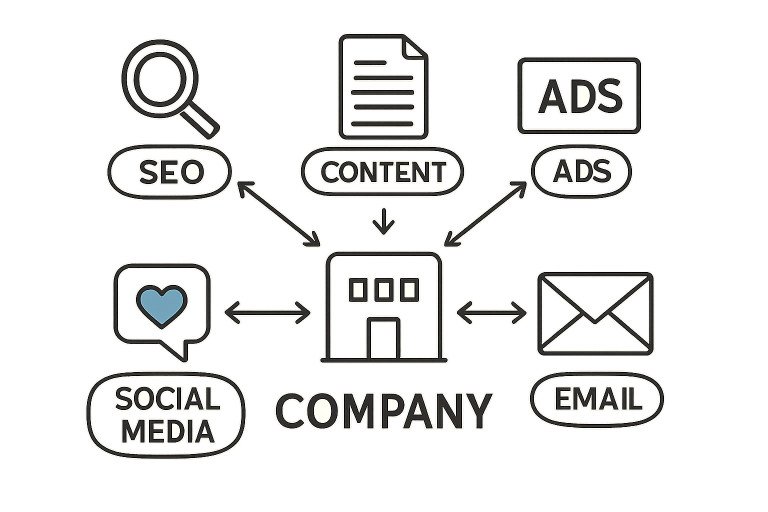
Customers today interact with brands across multiple platforms, from search engines and email to social networks and review sites. A comprehensive multi-channel strategy amplifies reach and ensures a portfolio company’s brand remains visible at every stage of the buyer’s journey. Consistent, cohesive cross-channel messaging is vital for reinforcing conversion and retention. Meanwhile, diversified channel investment mitigates the risks associated with dependence on any single platform. For B2B and B2C portfolio companies alike, leveraging owned, earned, and paid digital assets in tandem delivers superior results versus siloed, single-channel approaches.
Investing in SEO and Content Marketing
SEO and content marketing represent bedrock tactics for generating sustainable growth, particularly for lower-funnel acquisition. SEO increases visibility in unpaid search results, driving high-intent traffic. Meanwhile, high-quality content establishes thought leadership, builds trust, and educates the market throughout the sales funnel. Content formats may include blogs, white papers, case studies, and videos. When executed in tandem, SEO and content marketing not only provide portfolio companies a reservoir of organic inbound leads but also power lower customer acquisition costs over time. Content marketing tends to reduce customer acquisition costs (CAC) over time, while paid advertising often sees an annual rise in CAC.
Utilizing Paid Advertising
PPC advertising, particularly through search and social channels, empowers companies to launch targeted campaigns that generate results quickly. By honing audience segments and refining keyword lists, portfolio companies can attract prospects who are actively expressing intent. Importantly, ongoing campaign management and bid optimization are critical to ensuring efficient ad spend. As paid channels typically require more budget, tracking granular metrics such as ROAS (return on ad spend) helps ensure campaigns deliver positive returns and can be scaled profitably.
Embracing AI and Automation
AI-driven martech tools have rapidly transformed the ability to capture, process, and act on massive datasets. Automation supports campaign management, lead nurturing, and personalization at scale. Machine learning models help predict customer behavior and prioritize leads. By delegating routine activities to automation platforms, marketing teams free up time for creativity, strategy, and testing. The result is a digital marketing machine that is streamlined, adaptable, and always learning.
Continuous Testing and Optimization
Optimization must be continuous, not episodic. Regular testing, ranging from landing page variants to email subject lines, unlocks marginal gains that add up to significant gains over time. Companies that commit to a robust “test and learn” culture are best positioned to adapt to changing market conditions and evolving customer preferences. Insights gained should be integrated into future strategies to create a feedback loop, enabling future campaigns to become incrementally stronger and more efficient. Making small, ongoing improvements can lead to substantial performance gains over the long run.
By prioritizing these strategies, private equity portfolio companies can build and reinforce a digital marketing ecosystem that continually maximizes ROI. This not only accelerates near-term growth but also builds a lasting foundation for exit value and long-term brand equity.